|
Volcanic emissions monitoring |
|||||||||||||||||||||

Tropospheric
|
||||||||||||||||||||||
|
|
|
NO2
- global CH2O - global CO - global |
|
|
|
UV
- UV index - UV dose |
|
|
|
Ozone
- total column - global field - ozone bulletin - ozone profiles - tropospheric |
|
|
|
Aerosol
- ADRE - aerosol index Methane - global CO2 - global Clouds - cloud info Surface - solar irradiance |
|
|
|
Volcanic plume
- SO2 & AAI |
|
|
|
Albedo
- climatologies Fluorescence - sun-induced |
08 February 2024
Volcano eruptions are important sources of gases, such as sulphur dioxide (SO2), and volcanic ash (aerosols) in the atmosphere. These emissions may have an impact on air traffic: near-real time information on the emissions of volcanic ash and sulphur dioxide will enable better planning of air line routes. If the SO2 concentrations in a given region exceed a limit, a warning is issued of a possible volcano eruption.
NRT volcanic SO2 and ash images from multiple satellite instruments: TROPOMI, OMPS, OMI, GOME-2, IASI and AIRS

|
| Near-real-time images of SO2 and the aerosol index |
This NRT data service is part of the Support to Aviation Control Service (SACS), which is hosted by BIRA-IASB, Brussels, Belgium.
Archives of volcanic SO2 and ash
- Archive of the AAI from multiple instruments
- Archive of notifications of
exceptional SO2 concentrations
- Time coverage of the data sets
Acknowledgement
- The GOME-2 data products were generated under the auspices of EUMETSAT's ACSAF project (formerly called O3MSAF).
Additional information
- Main page of the Support to Avaition
Control Service (SACS) website
- On-line product information
- Some highlights of SO2 and ash emissions related to volcanic eruptions
(some links lead to external pages):
- MPEG movie of the erupting Grímsvötn (Iceland) and Nabro (Eritrea) volcano (4MB) -- May/June 2011
- Eyjafjalljökull volcano on Iceland -- April 2010
- Highlights of SO2 emissions related to volcanic eruptions on the
SACS website:
- Grímsvötn volcano on Iceland - May 2011
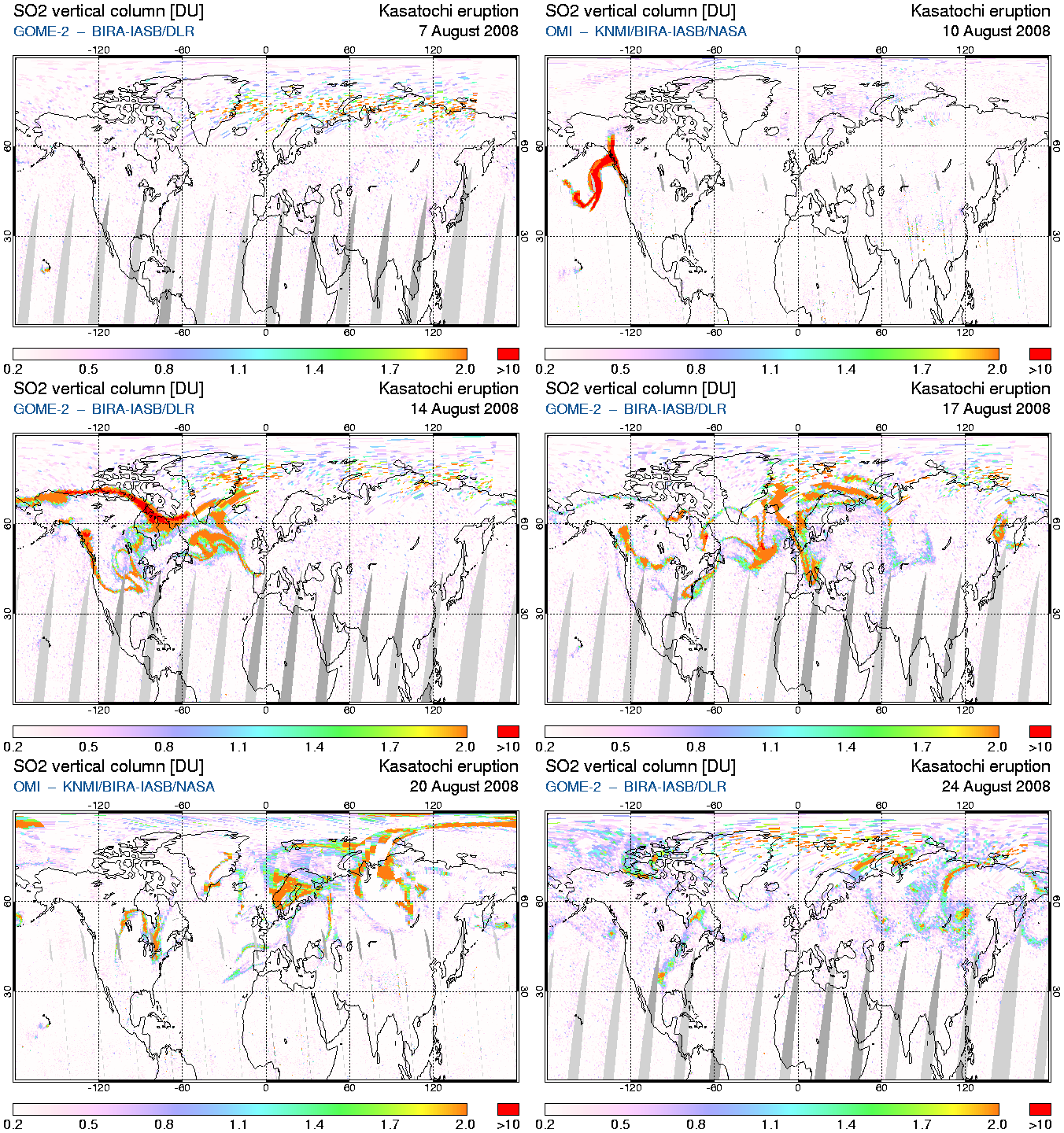
- Kasatochi
volcano on the Aleutian Islands (August 2008), when SO2 is
transported rapidly across the Northern Hemisphere
- MPEG movie of SO2 from OMI data on a rotatingEarth (3.4MB)
- Animated GIF of SO2 from both GOME-2 and OMI in cylindrical projection (2.7MB); note that GOME-2 measures about 4 hours before OMI does
- Piton de la Fournaise volcano on Réunion Island -- March/April 2007
- Grímsvötn volcano on Iceland -- November 2004