Eruption of the Eyjafjalljökull volcano
April 2010

Eruption of the Eyjafjalljökull volcano
|
|
Eruption of the Eyjafjalljökull volcano
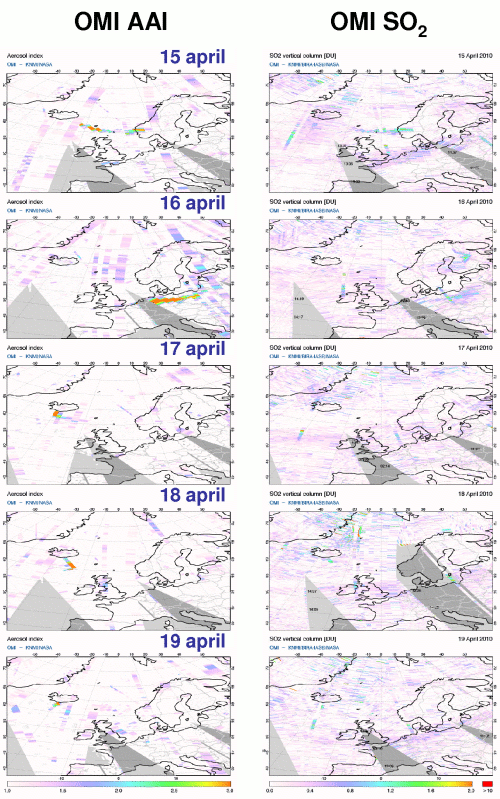
On Wednesday, April 14 2010, the Eyjafjalljökull started to erupt. The ash cloud curled around a high pressure zone above the British Isles in the direction of northwest Europe. On Thursday, April 15, around 12:00 hours OMI detected a plume of highly elevated ash and sulfur dioxide concentrations between Iceland and northwestern Europe. A day later, on Friday April 16, the ash plume travelled further south and was seen from space over the north of Germany and Poland. In the subsequent days the aerosol and sulfur concentrations started to dilute such that the ash plume over Europe is no longer noticeable by satellite. However, from Saturday until Monday, April 17-19, the new supply of ash from Iceland is clearly seen in the OMI measurements.Image on the right
An aerosol index of 1 (white) indicates relatively clean air, while an index of 3 (orange) means the sky is polluted with dust.The SO2 concentrations are given in "Dobson Units" (1 DU = 2.69 1016 molecules per cm2). Typical background concentrations are lower than 0.5 DU. Close to the Eyjafjalljökkul volcano concentrations of 1-2 DU are observed. These concentrations are not extremely high for a volcanic eruption, for example, at the eruption of the Kasatochi in August 2008 concentrations of more than 15 DU are observed.
Related links
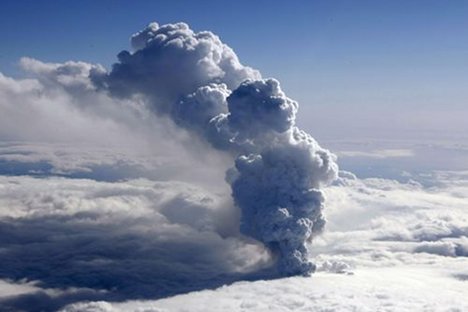
Image on the right: Eyjafjallajökull on 15 Apr. 2010. (© Saeberg/Reuters)
 last modified: 10 December 2020
Contact form
Copyright © KNMI / TEMIS