EOS-Aura/OMI NO2 slant column retrieval:
stability & uncertainties

| TROPOMI : | Introduction | Wavelength calibration |
| OMI : | Introduction | Wavelength calibration |
EOS-Aura/OMI NO2 slant column retrieval:
|
|
|||
|
Wavelength calibration of the (ir)radiance
Note: The data presented are from a preliminary version of the collection 4 data. The final version of the data, extending to the end of the OMI mission, will be presented here in due time -- differences are, however, expected to be small.Prior to the NO2 slant column retrieval, a wavelength calibration is performed on the input level-1b radiance, which provides a wavelength shift that is applied to the nominal wavelengths of the level-1b spectra. In the OMI collection 4 NO2 retrieval, the irradiance is fixed to the corresponding collection 4 2005 yearly average irradiance. Since the wavelength calibration results of this are always the same, there is no need to monitor that over time.Figure 1 shows the wavelength calibration offsets of the OMI radiance of 1 July 2005 (red) and of 1 July 2022 (blue), where for the latter several rows (across-track pixels) are omitted because of the row anomaly. For comparison the wavelength calibration offset of the OMI irradiance is shown as well (gray).
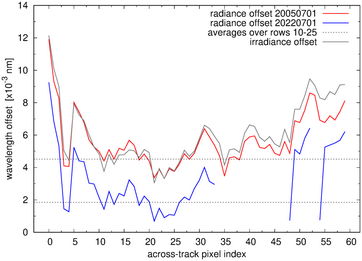
Figure 1
Wavelength calibration offsets of the OMI radiance of 1 July 2005 (red) and of 1 July 2022 (blue) as well as of the irradiance (gray), where the radiance offsets are an average over the Tropical Latitude (TL) range, as function of the across-track ground pixel index.The horizontal black dashed lines show the averages of the offsets of rows 10 - 25.
The broad across-track shape and the average value of the wavelength offset visible in the Fig. 1 are not important, as they result from the choice of the nominal wavelength grid of the level-1b spectra. The change in time of the average wavelength offset and of the row-to-row variation in the wavelength offset, however, give an idea of the stability of the level-1b spectra and hence of the instrument.
For TROPOMI these changes over time are monitored by looking at the average over the central third of the rows. In view of the row anomaly such a choice is not possible. Instead, the average over rows 10 - 25 (inclusive) is used for the monitoring.
Figure 2 shows the wavelength calibration offsets of the OMI radiance of 1 July 2005 (red) and of 1 July 2022 (blue) after subtraction of the average. Clearly, for most of the swath the offsets are very similar. Only around the row anomaly there can be large differences.
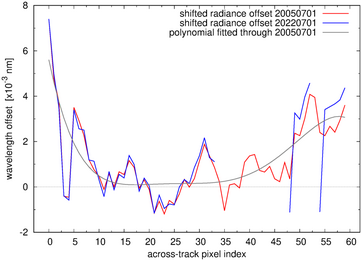
Figure 2
Wavelength calibration offsets of the OMI radiance of 1 July 2005 (red) and of 1 July 2022 (blue) after these are shifted with the average over rows 10 - 25.A polynomial fitted through the shifted offsets of 1 July 2005 is shown in gray. The across-track RMS of the radiance wavelength offsets is computed w.r.t. this polynomial.
Figure 3 shows the change over time of the offset averaged over rows 10 - 25, while Figure 4 shows the evolution of the RMS w.r.t. the polynomial shown in Fig. 2. This RMS can be seen as a measure for the across-track "stripiness" -- i.e. the row-to-row variation -- of the wavelength offsets.
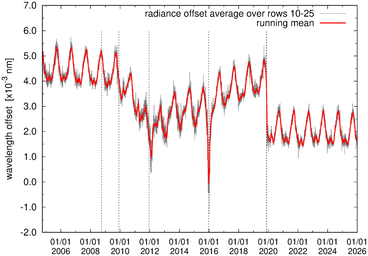
Figure 3
Evolution of the wavelength calibration offset averaged over rows 10 - 25.The thin gray line shows the individual days, while the thick red line is a 21-day running mean through that.
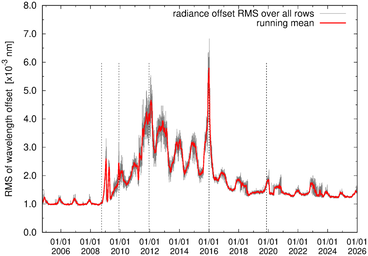
Figure 4
Evolution of the across-track RMS of the wavelength calibration offset w.r.t. the polynomial shown in Fig. 2.The thin gray line show the individual days, while the thick red line is a 21-day running mean through that.
The above two graphs show a clear seasonal cycle, with largest offsets in September. On top of this seasonal cycle a few changes in the pattern stand out, indicated by dashed vertical lines:
Even though the average wavelength offset shown in Fig. 3 is based on an average over rows not affected by the row anomaly, the wavelength offset appears to change with some of the changes in the row anomaly. Perhaps this is because the overall illumination of the whole detector is affected by the row anomaly.
- 30 Sep. 2008
This is right after an unscheduled two days of missing data. After this, the RMS appears to grow, with a first peak value around 1 Nov. 2008. In Dec. 2008 the row anomaly really kicks on row 41, followed soon by rows 42-45; see Fig. 2 on this page for details.
- 1 Dec. 2009
As of around this date the row anomaly permanently affects row 26 (with some effects already visible earlier), soon followed by row 27. Until about this date the wavelength offset without the seasonal cycle seems more or less constant; after this date the wavelength offset clearly decreases for some time.
- 15 Dec. 2011
The effect of the row anomaly on rows 42 - 45 seems to stop as of this date, coming back up again around 20 March 2014. The decrease in the wavelength offset seems to end at around this date: from now on the wavelength offset slowly increases, similar to the increase seen for TROPOMI, probably linked instrumental degradation, changes in the gain drift, etc.
- 21 Dec. 2015
There is a strong downward peak in the wavelength offset, starting mid nov. 2015 until around mid Feb. 2016. It is unclear what the cause of this peak is; there are no instrumental issues known in the records that are specific for this period, and there appears to be no link with (changes in) the row anomaly. It does, however, seem to have an effect on the across-track RMS of the wavelength offset: its magnitude and seasonal variation is clearly smaller after this peak has settled down.
- 16 Nov. 2019
The slow average increase of the wavelength offset that started around Dec. 2011 ends here with an abrupt change. This abrupt change is caused by a change in the heater settings of the Optical Bench (OPB; the heater power was reduced from 10 Watt to 8 Watt), which clearly had an impact on the detector: the pre-flight calibration that provided the nominal wavelength grid for the radiances -- on top of which the NO2 is applied -- was no langer valid.
 last modified: 08 October 2026
Contact:
Jos van Geffen < geffen [at] knmi [dot] nl >
Copyright © KNMI / ESA


