EOS-Aura/OMI NO2 slant column retrieval:
stability & uncertainties


| TROPOMI : | Introduction | [ N/A ] |
| OMI : | Introduction | Row anomaly |
EOS-Aura/OMI NO2 slant column retrieval:
|
|
|||
|
Row anomaly
Note: The data presented are from a preliminary version of the collection 4 data. The final version of the data, extending to the end of the OMI mission, will be presented here in due time -- differences are, however, expected to be small.Since June 2007 OMI has suffered from the so-called 'row anomaly' phenomenon, where certain cross-track fields of view (rows) are seemingly blocked, resulting in abnormally low radiance reading.The Level-1b data product provides an across-track flag for the row anomaly (copied to
xtrack_qualityin the NO2 data product). This flag distinguishes between different reasons for the anomaly, but from the NO2 data point of view only "not affected" (flag value zero) or "affected" (flag value larger than zero) is relevant. The row anomaly appears to be affecting different sets of rows south and north of a certain orbit phase (φ copied tosatellite_orbit_phasein the NO2 data product). The Level-1b processor makes the separation at φ=0.580.The Level-1b row anomaly flagging seems a little too strict at times, too loose at other times, and it is a fixed flagging. To be more flexible a "dynamic row anomaly flag" (written to
xtrack_quality_dynamicin the NO2 data product) is used, which just has a zero for "not affected" and a one for "affected", while it places the south-north separatation at φ=0.595. This dynamic flag is based on a per row along-track average of the absorbing aerosol index (AAI) in the OMAERO product: if the average AAI is above 1.25 (1.00) for the southern (northen) part then the row is flagged as "affected".As of halfway 08 July 2021 there is much less AAI-based flagging in the southern part of the orbit: much less rows are affected by the row anomaly there. This improvement of the row anomaly, however, is unfortunately not reflected in the L1B flagging. Hence, by not strictly adhering to the L1B flagging, we get more data.
On the other hand, the AAI-based flagging appears to also flag rows that are clearly not affected by the row anomaly: high AAI values can also be caused by other effects, such as dust events or retrieval problems at high solar zenith angle.
These considerations put together has made us decide to go for a combination of the L1B and the AAI-based flags for NO2:
In the analysis of the NO2 SCD retrieval results presented here, the rows marked as bad (black) are omitted.
- If both the L1B and AAI flag are set, the row is considered really bad:
the NO2qa_valuewill be multiplied by a very small number (e.g. 0.05; TBD)
== shown in black below
- If only the L1B flag is set, the row is possibly affected:
the NO2qa_valuewill be multiplied by a number slightly below 1 (e.g. 0.92; TBD)
== shown in light gray below
- If the L1B flag is not set, the row is considered to be OK, no matter what the AAI-based flag is:
the NO2qa_valuewill not be adapted
== shown in white below
- If the AAI-based flag is missing but there is NO2 data (which always has the L1B flag),
then the last known AAI-based flag is used. [1]Figure 1 shows the row anomaly flagging of the southern part for all Pacific Ocean orbits used in the analysis discussed here.
Vertical middle gray lines mark orbits missing from the analysis. Most of these missing orbits are related to switches to zoom mode observations by OMI (the last of which was on 11 Nov. 2019). Occasionally satellite or instrument problems have caused loss of data.
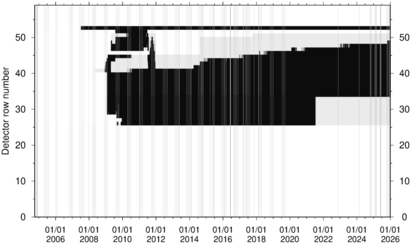
Figure 1
Row anomaly flagging in the southern part of the Pacific Ocean orbits used in the NO2 processing.The switch to zoom mode observations was very regular. The fact that this does not appear from the plot in Fig. 1 is lack of plot resolution: the number of horizontal pixels of the plot is less than the number of days of the displayed period.
Figure 2 shows a zoom plot of the southern row anomaly around the onset of the row anomaly for a large part of the rows, both to make this onsit visible and to at the same time to show the regular missing of orbits due to zoom mode observations.
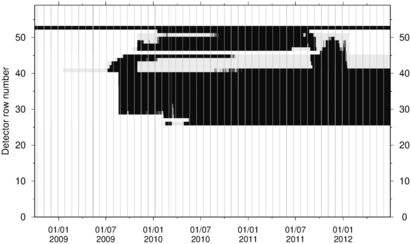
Figure 2
Zoom-in of Fig. 1 on the onset of the main part of the row anomaly.Figure 3 shows the row anomaly flagging of the northern part for all Pacific Ocean orbits used in the analysis here -- the row anomaly is clearly more severe in this part of the orbits, which is why the distinction between the parts is rather useful.
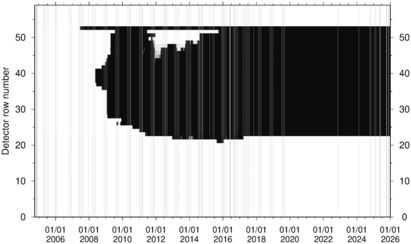
Figure 3
Row anomaly flagging in the northern part of the Pacific Ocean orbits used in the NO2 processing.
[1] In the initial reprocessing of OMI collection 4, AAI data was missing for two periods of about 100 days because of a problem with the moving irradiance average used for the AAI retrieval (as opposed to the NO2 retrieval, which uses a fixed irradiance): 20170317 to 20170628 and 20191011 to 20200124.
As a result of this, the AAI-based flag was of course also missing. For the results shown here, these gaps in the AAI-based flag were filled by used the last known flags.
The missing data periods have been reprocessed and once the new data is available, the analysis shown here will be done again -- it is not expected that this will affect these results visibly -- and once that is done, this note will be deleted.
 last modified: 08 October 2026
Contact:
Jos van Geffen < geffen [at] knmi [dot] nl >
Copyright © KNMI / ESA


