S5P/TROPOMI NO2 slant column retrieval:
stability & uncertainties


| TROPOMI : | Introduction | Wavelength calibration |
| OMI : | Introduction | Wavelength calibration |
S5P/TROPOMI NO2 slant column retrieval:
|
|
|||
|
Wavelength calibration of the (ir)radiance
Prior to the NO2 slant column retrieval, a wavelength calibration is performed on the input level-1b radiance and irradiance spectra, which provides a wavelength offset that is applied to the nominal wavelengths of the level-1b spectra. (For details see van Geffen et al., 2020, Sect. 3.2.1.)Figure 1 shows the wavelength offsets for an orbit on 1 July 2018 of the irradiance (red) and radiance (blue) as function of across-track ground pixel (row), where the radiance offset of each row is an along-track average over the Tropical Latitude (TL) range. Due to only partial instrument slit illumination at the outer two rows (0 and 449) the wavelength offset shows markedly different values for these rows. To avoid these peaks from overshadowing the effects discussed below, these outer two rows are skipped from the following analysis.
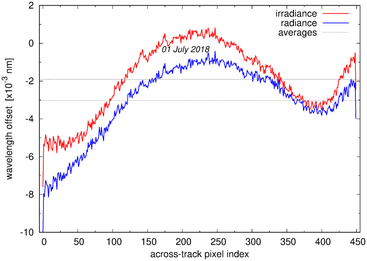
Figure 1
Wavelength calibration offsets of the TROPOMI irradiance (red) and radiance (blue), where the latter is an average over the Tropical Latitude (TL) range. Shifts for 1 July 2018 (radiance orbit 03711, with irradiance from orbit 03718) are shown as function of the across-track ground pixel index. The dashed horizontal lines are the across-track averages, with the exception of the two outer rows.The broad across-track shape and the average value of the wavelength offset visible in the Fig. 1 are not important, as they result from the choice of the nominal wavelength grid of the level-1b spectra. The change in time of the average wavelength offset and of the row-to-row variation in the wavelength offset, however, give an idea of the stability of the level-1b spectra and hence of the instrument.
Figure 2 shows the change over time of the average irradiance (red) and radiance (blue) wavelength offset. The offsets appear to increase slowly over time with a seasonal cycle on top of that. The amplitude of the seasonal cycle is about 0.002 nm, with "up" peaks mid Sept. that are higher and narrower than "down" peaks mid March. To make it easier to see this, linear fits over full years of the data period as of 1 May 2018 are shown by dotted lines. There is no evident change in the behaviour or magnitude of these offsets is related to updates of the level-1b (ir)radiance spectra.
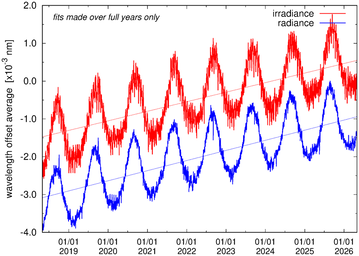
Figure 2
Change over time of the average irradiance (red) and radiance (blue) wavelength offset. The straight dotted black lines are linear fits over full years of the data period 1 May 2018 up to 30 April 2026.Figure 3 shows the absolute difference between the irradiance and radiance wavelength offsets of the above graph. This difference is fairly constant over time, with no clear seasonal effect visible.
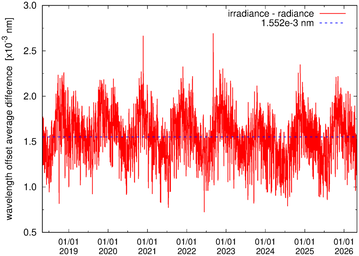
Figure 3
Absolute difference between the irradiance and radiance wavelength offsets of Fig. 2.The wavelength offsets shown in Fig. 2 have relatively large day-to-day variation, which makes comparing the behaviour of the two curves a little difficult. To solve this, a 21-day running mean is computed. Figure 4 shows these running means, where for comparion sake the radiance offset is adjusted by the average difference in the above graph.
Clearly, the behaviour of the irradiance and radiance wavelength offsets is more or less the same. The reason the irradiance wavelength offset seems to run a little behind the radiance wavelength offset could be related to selection of the irradiance spectrum, which is measured once every 15 orbits, for the processing of the radiance data.
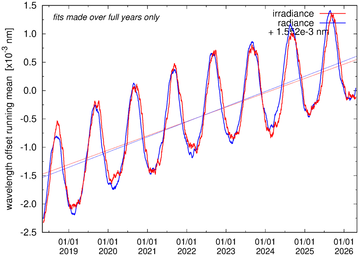
Figure 4
Running mean of the irradiance (red) and radiance (blue) wavelength offsets of Fig. 2, with the latter adjusted by the average difference from Fig. 3. The straight dotted black line connects the irradiance wavelength offsets of 1 May 2018 and 30 April 2026.Figure 5 shows the irradiance (red) and radiance (blue) wavelength offsets as function of the across-track ground pixel index of 1 July 2018, i.e. the curves of Fig. 1, and of 1 July 2022, where the latter are shifted down in the graph so that the curves can be distinguished better. The overall across-track shape of the wavelength offsets does not change noteably over time. The across-track "stripiness" -- i.e. the row-to-row variation -- of the wavelength offsets does appear to increase over time.
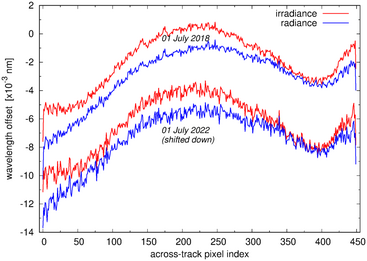
Figure 5
Wavelength calibration offsets of the TROPOMI irradiance (red) and radiance (blue) for 1 July 2018 and 1 July 2022 (top two lines, shown also in Fig. 1) and 1 June 2022 (bottom two lines; radiance and irradiance orbit 24013, shifted by 6e-3 to make it easier to distinguish the curves).The "stripiness" of the wavelength offsets can be expressed by the across-track root-mean-square (RMS) of the offsets (skipping the outer two rows, as mentioned above), where the RMS is computed w.r.t. a polynomial fitted through the wavelength offsets, so as to filter out the overall across-track shape from the RMS.
Figure 6 shows this RMS as function of time. Clearly, the "stripiness" increases over time, in a similar way for both spectra but with larger variation for the radiance (blue) than for the irradiance (red), where the RMS of the radiance offsets appears to have a seasonal cycle, which is not present in the irradiance offsets.
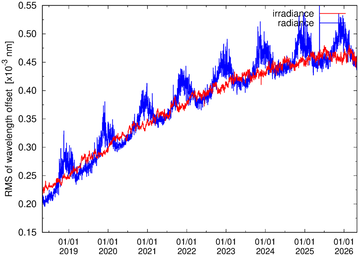
Figure 6
Change over time of the across-track RMS of the irradiance (red) and radiance (blue) wavelength offsets, after subtraction of a polynomial fitted through the across-track wavelength offset values.To make the difference in the change over time of the radiance and irradiance easier visible, Figure 7 shows 21-day running means through the RMS. Linear fits through the complete years of the full data range indicate that the RMS of the radiances seems to increase over time a little more than the RMS of the irradiance. Comparing these straight lines with the data shows clearly by now that the increase over time is not linear: during the first few years the increase was faster and over the past few year the increase is slowing down.
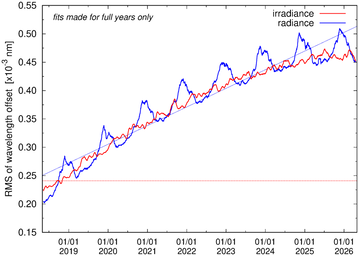
Figure 7
Change over time of the running mean of across-track RMS of the irradiance (red) and radiance (blue) wavelength offsets shown in Fig. 6; the dotted lines are linear fits over full years of the data period 1 May 2018 up to 30 April 2026.
Concluding note
These changes over time in both the (ir)radiance wavelength offsets and the across-track "stripiness" of these are small and within instrument specification. Still, it is worthwhile to monitor these quantities.
 last modified: 08 October 2026
Contact:
Jos van Geffen < geffen [at] knmi [dot] nl >
Copyright © KNMI / ESA


