SCD error estimate & statistical uncertainty
The uncertainty of the retrieved SCDs is an important quantity: the lower
the uncertainty, the higher the quality of the SCDs and hence of the
subsequent NO2 data product.
On the one hand, the DOAS retrieval of the SCDs provides an estimate of the
SCD error.
On the other hand, the spatial variability of the SCDs over a remote Pacific
Ocean sector can be used as an independent statistical estimate of the
random component of the SCD uncertainty.
For the analysis of both these indicators, all ground pixels of a given
Pacific Ocean orbit with latitudes in the range [-60°:+60°] are
considered, divided into three cloud regimes:
- all pixels with valid retrieval: qa_value > 0.50
- clear-sky pixels (i.e. pixels with a cloud radiance fracton < 0.5):
qa_value > 0.75
- cloudy pixels: 0.50 < qa_value < 0.75
(For details see
van Geffen et al., 2020 (Sect. 4.6),
2026 (Sect. 2.2.2).
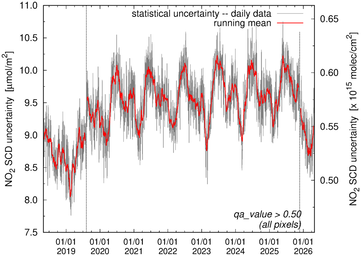
Figure 1 shows the SCD statistical uncertainty over all valid pixels
with gray lines. This quantity clearly varies considerably from day to day.
To make the analysis visually easier, a 21-day running mean, shown in red in
Fig. 1, is more convenient. Hence, the subsequent plots on this page show
the running means, though the averages and trend lines shown are based on
the original daily data.
|
|
Figure 1
SCD statistical uncertainty daily data (thin gray line) and 21-day running
mean (red) using all pixels with successful retrieval, as function of time.
Vertical lines indicate specific moments in time.
See the text for further details.
|
Fig. 1 shows two vertical lines:
- On 6 Aug. 2019, which is when the along-track size of the TROPOMI
ground pixels was reduced, per pixel resulting in a smaller signal
and hence inevitably leading to larger per-pixel uncertainties.
- On 22 Nov. 2020, which is when the DOAS fit is changed to exclude the
wavelength range 428-433 nm, thus avoiding a potential problem; see
van Geffen et al., 2026.
Hence, the following analysis is split at these points and the
running mean is not continued across these dates.
All data shown on this page comes from the collection 03 dataset, which
starts on 01 May 2018.
This dataset has statistical uncertainties that are higher by 0% to 1% than
the older collection 01 & 02 datasets, and DOAS uncertainties that are
lower by 1% to 2%.
These changes are mainly related to updates of the NO2 algorithm
during the collection 01 & 02 period (cf. van
Geffen et al., 2022, 2026) and so small that they are not discussed any
further here.
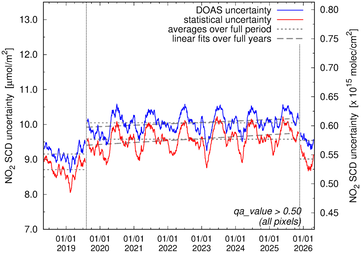
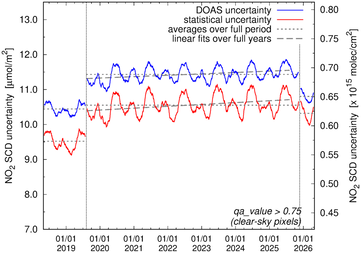
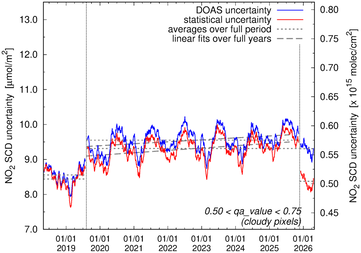
The DOAS (blue) and statistical (red) uncertainties are shown in
Figure 2 for all ground pixels with a valid retrieval, in
Figure 3 for clear-sky pixels only, and in
Figure 4 for cloudy pixels only.
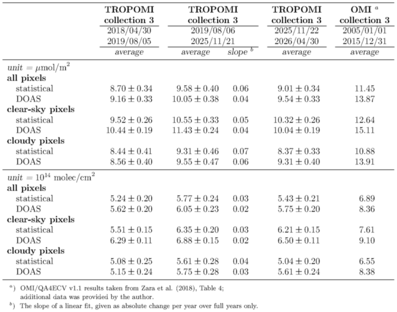
Horizontal lines are used to indicate the averages; the numbers are given in
Table 1 below.
-
The period before the ground pixel size reduction on 6 Aug. 2019 is too
short to be able to say whether there is a trend in that part of the
uncertaintaies.
-
During the five years after 6 Aug. 2019 it looks like there may be a trend
of increasing uncertainties; the slope of the fitted lines (dashed-black) is
given in Table 1 below.
The variation of the uncertainties throughout the year, however, is quite
large and the data periods are quite short so that it difficult to be sure
whether there really is a trend, or
whether there are natural (atmospheric) effects playing a role.
-
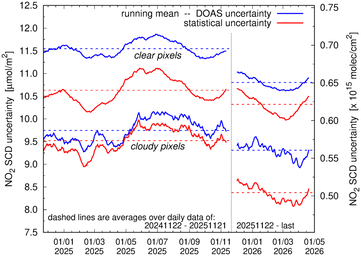
The change in the DOAS fit as of 22 Nov. 2025 marks another seperation;
the period after that is still too short to give averages with any certainty,
but the indication so far is that the uncertainties are reduced -- see the
zoom-in in Figure 5.
|
|
Figure 2
SCD DOAS uncertainty estimate (blue) and statistical uncertainty (red)
21-day running means using all pixels with successful retrieval, as function
of time.
Dotted horizontal lines indicate averages over both periods, while dashed
lines indicate a linear fit over full years of the period starting 6 Aug.
2019.
Vertical scales of Figs. 2-4 are the same to ease comparison between the
three cloud regimes.
|
|
|
Figure 3
As Fig. 2, but for clear-sky pixels only.
|
|
|
Figure 4
As Fig. 2, but for cloudy pixels only.
|
|
|
Figure 5
Zoom-in on the effect of the change in the DOAS fit as of 22 Nov. 2025 on the
uncertainties of clear and cloudy pixels.
Dashed horizontal lines show the averages over the one year prior to the change
and over the available data after the change.
|
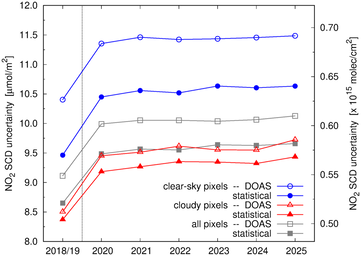
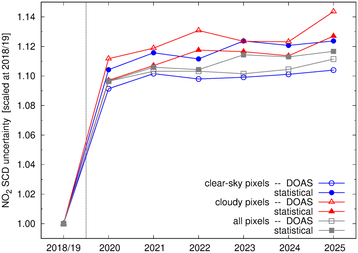
Another way to look at changes over time without seasonal
variation obscuring those changes is shown in Figure 6: yearly
average uncertainties, where due to the ground pixel size reduction in 2019,
the first year is not a calendar year but rather Aug. 2018 - July 2019.
This graph shows more clearly -- as can be seen from the numbers in Table 1
-- that the ground pixel size reduction leads to an increase of the
uncertainties of about 10%. After that, the uncertainties remain unchanged
to within 2%.
Given the change as of 22 Nov. 2025, averaging over all 2025 data is
strictly speaking not valid, but since the change affects only about 10%
of the days, the yearly average is still reasonably reliable.
|
Figure 6
Yearly averaged DOAS and statistical uncertainties of calendar years 2020
onwards and of the period Aug. 2018 - July 2019 before the ground pixel size
reduction in Aug. 2019 (the division is indicated by the vertical dotted
line), in absolute numbers (left) and relative to 2018/19 (right).
|
|
|
Table 1
SCD statistical uncertainty and DOAS uncertainty estimates averaged over the
listed periods and the slope of a linear fit through full years of TROPOMI
data after the ground pixel size reduction on 6 Aug. 2019, for the three
different cloud regimes, all given in two units.
For comparison, the values from OMI/QA4ECV from Zara et al., 2018 are given in the last column.
For a discussion on and extension of the OMI data, see this page.
This table is an update of the numbers in
van Geffen et al., 2020, Table 3,
which was based on collection 01 data up to 31 Jan. 2020.
|
See also the page on the OMI uncertainties using
(re)processed collection 4 data.
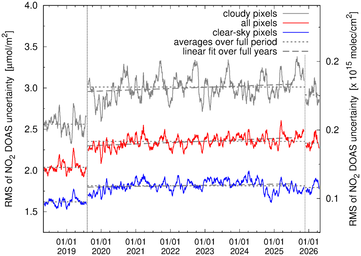
Figure 7 shows the running mean of the RMS of the average DOAS
uncertainty shown in Figs. 2-4.
There may be a small increase in the RMS since the ground pixel size
reduction.
|
|
Figure 7
21-day running means of the RMS of the DOAS uncertainty.
Dotted horizontal lines indicate averages over both periods, while the
dashed line indicates a linear fit over full years of the period starting 6
Aug. 2019.
|
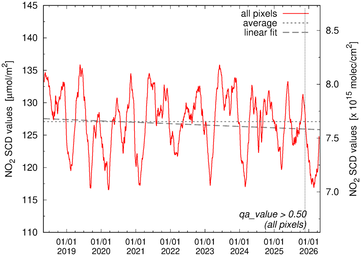
Figure 8 shows the running mean of the average SCD values of all
ground pixels of Pacific Ocean orbits that lie with the latitude range
[-60°:+60°] for the full data period.
There is quite a bit of variation in the SCD over time, with a possible
downward trend.
As expected, there does not seem to be a change in the SCD values related to
the ground pixel size reduction.
The change implemented on 22 Nov. 2025 is likely to lead to lower SCD
values, but it is too early to tell how clear this is, hence the averaging
and linear fit in Fig. 8 are not split at that point in time yet.
|
|
Figure 8
21-day running mean of the SCD values of all ground pixels.
The dotted horizontal line indicates the average over entire period and the dashed
line indicates a linear fit over the entire period, i.e. not limited to full
years.
|