S5P/TROPOMI NO2 slant column retrieval:
stability & uncertainties


| TROPOMI : | Introduction | Vertical NO2 column monitoring |
| OMI : | Introduction | Vertical NO2 column monitoring -- to come |
S5P/TROPOMI NO2 slant column retrieval:
|
|
|||
|
Vertical NO2 column monitoring
This page looks at the variation in time of vertical NO2 columns:as well as at differences between the current collection 03 data and the old collection 01 & 02 data, using averages over the "Tropical Latitude" (TL) range over the Pacific Ocean.
- The geometric column density (GCD), which is the slant column density (SCD) divided by the geometric air-mass factor (AMFgeo) -- a useful quantity to monitor, since the SCD depends strongly on the along-track and across-track variation in solar and viewing zenith angles.
- The vertical column density (VCD), calculated using appropratie air-mass factors determined by the data assimilation system TM5 in the NO2 processing chain:
- The total VCD
- The stratospheric VCD
- The tropospheric VCD
Figure 1 shows the across-track average corrected GCD value over time, i.e. the average NO2 concentrations over the Pacific Ocean, away from source, most of which is stratospheric NO2. The temporal variation in this curve is due to atmospheric circumstances; there does not appear to be a trend in it. There also does not appeaer to be a clear change in the GCD related to either of the updates in the processor, which is as expected.
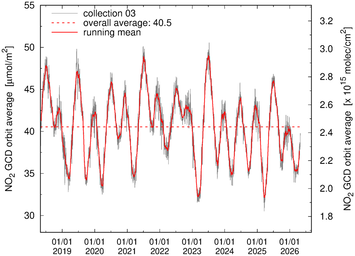
Figure 1
Across-track average GCD value as function of time of the collection 03 data in light-gray and in red a 21-day running mean through the data.For clarity, the following graphs all show only the running mean curves, while averages shown are always determined from the real daily data.
Figures 2-5 shows the GCD, the total VCD, the stratospheric VCD, and the tropospheric VCD, respectively.
- The left graph shows the vertical column quantity itself, with in red the current collection 03 data (based on level-1b version v2.1 spectra) and in blue the old collection 01 & 02 data (based on level-1b version v1.0 & v2.0 spectra).
- The first two vertical straight lines indicate the ends of the collection 01 & 02 periods on 1 July 2021 and 17 July 2022, respectively.
- The third vertical straight line indicates 22 Nov. 2025 -- see below.
- The right graph shows the difference between the collections.
- In these plots a third vertical line indicates a major switch in the NO2 processor itself on 20 March 2019 -- apart from updates in the NO2 retrieval itself that date also marks a major upgrade of the data assimilation system TM5, which is why there are large differences in the difference plots of Figs. 3-5 before that date.
The large difference in the GCD over the collection 01 period is primarily due to improvements in the NO2 slant column retrieval algorithm. Improvements in the level-1b spectra lead to small changes in the GCD, as indicated by the difference.
Since the data used for this analysis is over the Pacific Ocean, a region where there are few to no NO2 sources, the NO2 is primarily stratospheric. Hence, differences in the GCD end up primarily in the stratopsheric VCD (Fig. 4) and differences in the tropospheric VCD (Fig. 5) are small.
The difference between the GCD and the total VCD is that the first is calculated from the geometric air-mass factor and thus does not contain any atmospheric information, while the latter is calculated from the air-mass factor which is determined by the data assimilation system TM5 and thus also atmospheric information.
On 22 November 2025, the start of v2.9.1, changes in the DOAS slant column fit were introduced, which reduce the slant column uncertainties (cf. this page) and also reduces the GCD and the stratospheric VCD, and perhaps also the tropospheric VCD. This point is marked in the left panels below. Due to the shortness of the period, though, the averages are not split at that point in time yet.
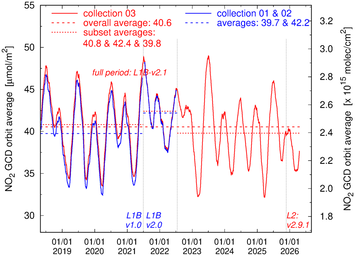
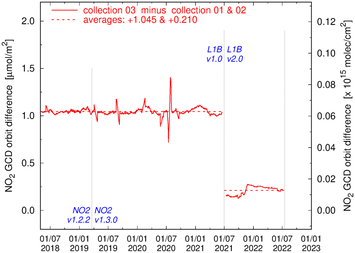
Figure 2
Across-track average GCD value as function of time.
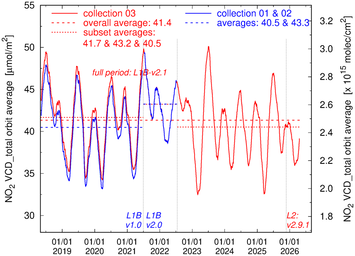
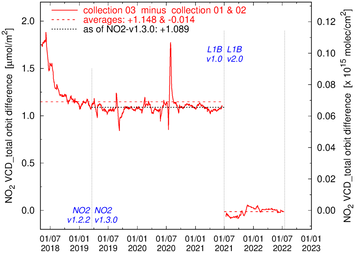
Figure 3
Across-track average total VCD value as function of time.
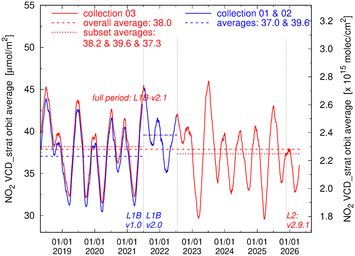
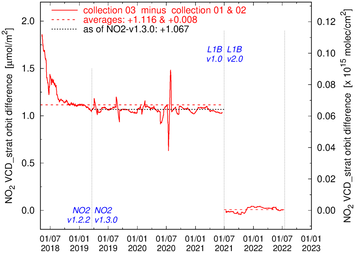
Figure 4
Across-track average stratospheric VCD value as function of time.
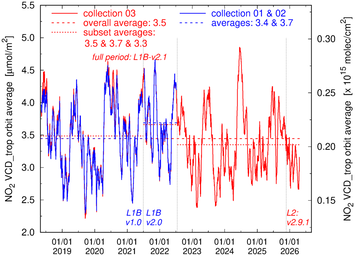
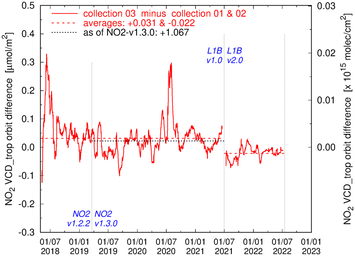
Figure 5
Across-track average tropospheric VCD value as function of time.
 last modified: 08 October 2026
Contact:
Jos van Geffen < geffen [at] knmi [dot] nl >
Copyright © KNMI / ESA


