S5P/TROPOMI NO2 slant column retrieval:
stability & uncertainties


| TROPOMI : | Introduction | Stripe correction amplitude |
| OMI : | Introduction | Stripe correction amplitude -- to come |
S5P/TROPOMI NO2 slant column retrieval:
|
|
|||
|
Stripe correction amplitude
The operational TROPOMI de-striping, implemented to remove small but systematic across-track features and thus improve the data product quality, is determined from the "Tropical Latitude" (TL) range of orbits over the Pacific Ocean and a slant column stripe amplitude is determined for each viewing angle. In order to retain only features which are slowly varying over time, and in order to reduce the sensitivity to features observed during a single overpass, the SCD stripe amplitudes are averaged over a time period of 7 days, or about 7 Pacific orbits, before subtracting them from the SCDs. (For details see van Geffen et al., 2020, Sect. 4.3.)The SCD depends strongly on the along-track and across-track variation in solar and viewing zenith angles. To make evaluations and comparisons easier, the SCD is divided by the geometric air-mass factor (AMFgeo) and the resulting total column is called the "geometric column density" or GCD.Figure 1 shows an example of the SCD stripe amplitude (blue) given in the NO2 orbit files and that stripe amplitude converted to "GCD space" (red).
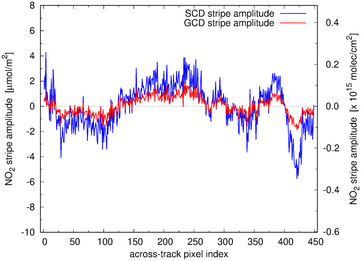
Figure 1
The SCD stripe amplitude (blue) given in the NO2 orbit files and that stripe amplitude converted to "GCD space" (red), for orbit 03711 of 1 July 2018 (collection 03 data).Figure 2 shows for the same orbit the effect of the de-striping on the GCD: after the correction the GCD is clearly smoother. Note (1) that the stripe correction amplitude itself is much smaller than the column values and (2) that the stripe correctio cannot fully remove all stripiness due to the day-to-day along-track and across-track natural variability of the NO2.
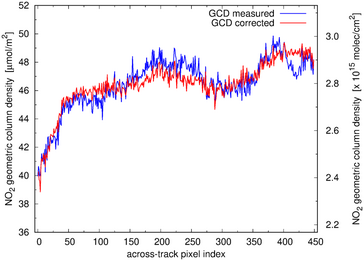
Figure 2
The measured (blue) and corrected (red) GCD for the same orbit as in Fig. 1, averaged over the TL range.Figure 3 shows the same GCD stripe amplitude as in Fig. 1 from 1 July 2018 (blue) as well as the GCD stripe amplitude from 1 July 2022 (red).
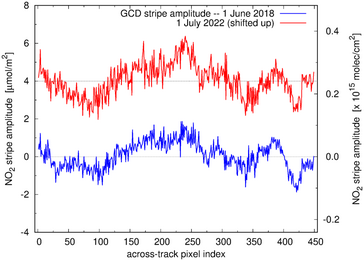
Figure 3
The GCD stripe amplitude for orbit 03711 of 1 July 2018 (blue; same as in Fig. 1) and for orbit 24439 of 1 July 2022 (red), where the latter is shifted upward so that the two curves can be distinguished easier. The stripe amplitude RMS values are 1.774 and 2.014 μmol/m2 (1.07e+14 and 1.21e14 molecules/cm2), respectively.Figure 4 compares the GCD stripe amplitude from 1 July 2018 of the current collection 03 data (blue, also shown in Fig. 3) with the old collection 01 data (red) -- the latter clearly has a somehwat larger stripiness.
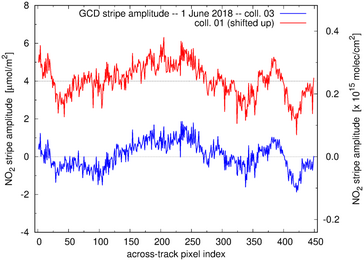
Figure 4
The GCD stripe amplitude for orbit 03711 of 1 July 2018 (blue; same as in Fig. 3) of the current collection 03 data and for the same orbit from the old collection 01 data (red), where the latter is shifted upward so that the two curves can be distinguished easier. The stripe amplitude RMS values are 1.774 and 2.199 μmol/m2 (1.07e+14 and 1.32e14 molecules/cm2), respectively.The across-track structure and the magnitude of the stripe amplitude vary in time, but the overall behaviour is fairly constant. A measure for the stability of the SCD stripe amplitude is the RMS of the across-track stripe amplitude.
Figure 5 shows this RMS as function of time and Figure 6 shows the same in the form of a 21-day running mean, which makes seeing the overall behaviour easier. Both graphs contain the current collection 03 data (red) and the old collection 01 & 02 data (blue).
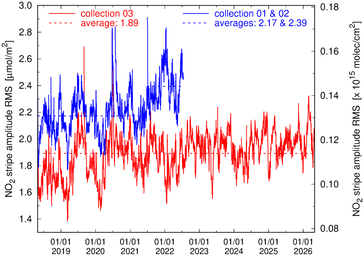
Figure 5
Change over time of the RMS of the SCD stripe amplitude of the current collection 03 (red, with level-1b data version v2.1) and the old collection 01 & 02 (blue, with level-1b data versions v1.0 & v2.0) data. Horizontal dashed lines show averages over the different data collection periods; numerical values are given in the legend.
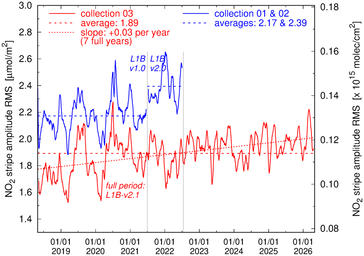
Figure 6
21-day running mean of the RMS of the SCD stripe amplitude of Fig. 5; the horizontal dashed lines are the same, while dotted lines show a linear fit through the collection 03 daily data (full years only).The current collection 03 has an average stripe amplitude RMS of 1.86 μmol/m2 (1.12e+14 molecules/cm2), which is 17% lower than the old collections 01 (average 2.17 μmol/m2, 1.31 molecules/cm2) and 29% lower than collection 02 (average 2.39 μmol/m2, 1.44 molecules/cm2).
The main reason for these changes lies in the different versions of the level-1b radiance and irradiance spectra. Compared to the L1B-v1.0 spectra of collection 01, the L1B-v2.0 spectra of collection 02 have some improvements, including a degradation correction of the irradionce but not of the radiance. A radiance degration correction was only implemented as of L1B-v2.1 for collection 03, and this appears to have a large impact on the across-track stripiness of the reflectance data used for the NO2 retrieval.As Figure 6 shows, by way of dotted lines, there is a small increase in the RMS of the stripe amplitude over time of about 0.03 μmol/m2 per year (1.91e+12 molecules/cm2), probably related to remaining degradation effects.
The TROPOMI stripe amplitude RMS, with an average of 1.86 μmol/m2, is about half of the same quantity for OMI (QA4ECV v1.1, which uses OMI collection 3 data) in its early years: averaged over 2005 it is 3.96 μmol/m2. And in the case of OMI the stripe amplitude RMS increases considerably over the years: averaged over 2009 it is 5.68 μmol/m2, an average increase of 0.43 μmol/m2 (2.59e+13 molecules/cm2) per year, which is quite a bit more than the the average increase of the TROPOMI stripe amplitude RMS.
Figure 7 shows the stripe amplitude for each row averaged over the full data period with standard deviation of that averaging, and Figure 8 shows the same average with an across-track smoothing to better show the overall structure in the striping, which appears to be rather consistent over time.
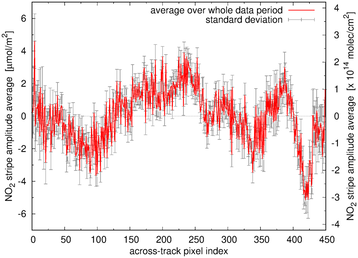
Figure 7
Stripe amplitude average over time for the full data period per row (red) with standard deviation of that averaging (light gray).
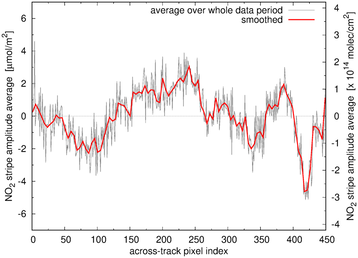
Figure 8
Stripe amplitude average over time for the full data period per row from Fig. 7 (light gray) and with an across-track smoothing (red).Figure 9 shows as example the stripe amplitude of three selected rows over time: there appears to be no significant or systematic change over time.
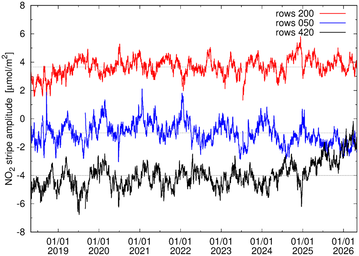
Figure 9
Evolution of the stripe amplitude of some selected rows; the dotted liens are averages.
The mission reprocessing (RPRO) of collection 03 (NO2 version v2.4.0) was from 01 May 2018 up to and including 25 July 2022, while the forward offline processing (OFFL) of that collection was started on 17 July 2022. At the start of this OFFL processing the RMS of the stripe amplitude was larger than during the ongoing RPRO processing, as illustrated in Figure 10, while after about 6 days they are the same.The reason for this is the need for a spin-up of the data assimilation system, which determines the stripe correction amplitude. In addition to that the stripe correction amplitude is determined from a weighted average over 7 days, which could of course not be done at the beginning of OFFL processing. This is why data users are recommended to continue the RPRO part of the collection 03 up to the end and only then switch to the OFFL part.
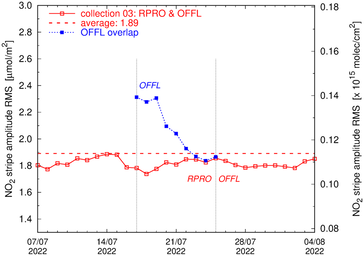
Figure 10
Zoom-in on the the daily stripe amplitude RMS of the collection 03 data (red open squares along solid line, same data as in Fig. 5), and the start of the forward offline processing of that collection on 17 July 2022 until the end of the reprocessing period on 25 July (blue filled squares along dotted line).
Some further remarks regarding issues with the collection 01 & 02 data, which are solved by the mission reprocessing collection 03 data:
- Around 25 June 2020 there is a spike in the stripe amplitude RMS, the cause of which is unknown; this data was not removed from the analysis.
- On 18 July 2020 there was an interuption of the processing, as a result of which the TM5-MP data assimilation was restarted, leading to a few days of unreliable stripe amplitude values (and hence reduced data quality). The stripe amplitude data of 19-25 July 2020 have been removed from the analysis.
- On 1 July 2021 the level-1b data version changed to L1B-v2.0 and this appears to lead to a spike in RMS of the stripe amplitude. This event was not removed from the analysis, as the spike (clearly visible in Fig. 5) was not extreme and spans only 2 or 3 days.
Another quantity than the RMS of the stripe amplitude which, as suggested at some point, could perhaps say something about the stripe amplitude stability is the across-track average of the absolute value of the stripe amplitude. It turns out, though, that that quantity shows the same behaviour: a straight line can be fitted between the two ("average" = 0.85 * "RMS" - 0.09). Hence, no graph of this "average" is shown here.
 last modified: 08 October 2026
Contact:
Jos van Geffen < geffen [at] knmi [dot] nl >
Copyright © KNMI / ESA


