UV index and UV dose: a short introduction

UV index and UV dose: a short introduction |
|
Subjects on this page: More detailed information can be found in the General data product description.
UV radiation
Electromagnetic radiation or "light" is the collective name for all forms of energy that move with the speed of light. There are different "types of light" in the spectrum, depending on their energy, which is related to the wavelength (freqency) of the light: the lower the wavelength, the higher the frequency and the higher the energy.The human eye is sensitive for only a part of the spectrum, referred to as "visible light": between about 400 and 780 nm (1 nm = 10-9 meter). The wavelength of the light determines the colour: 400 nm is blue, 700 nm is red.
The part of the spectrum immediately to the left of blue, between 200 and 400 nm is the ultraviolet light (UV). The UV is usually divided into three components, with increasing energy:
Of these UV-B is the most dangerous form, since part of it reaches ground level, where it can affect human health (e.g. cause certain forms of skin cancer) and damage the DNA of flora and fauna. Note that the wavelength of the division between the UV-A and UV-B bands is sometimes set at 315 nm.
- UV-A: 320-400 nm
- UV-B: 280-320 nm
- UV-C: 200-280 nm
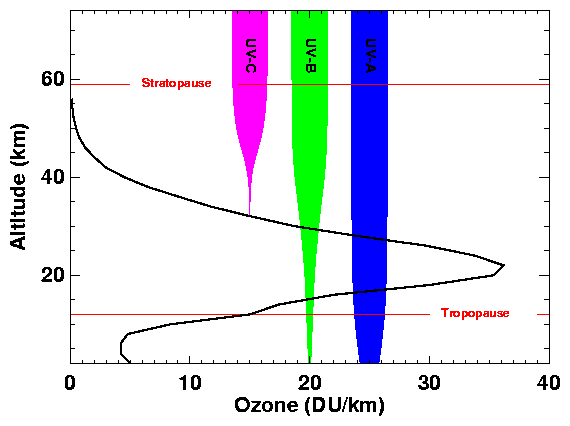
The UV-C energy is potentially more dangerous, but it decreases dramatically as ozone increases, because of the strong absorption in the 200-280 nm wavelength band. The UV-B is also strongly absorbed, but a small fraction reaches the surface. The UV-A is only weakly absorbed by ozone, with some scattering of radiation near the surface.
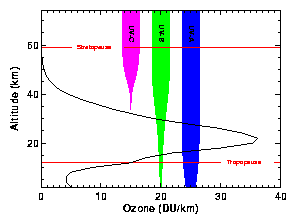
The curve shows a typical vertical profile of ozone in the midlatitudes of the northern hemisphere: the concentration of ozone as function of altitude. Superimposed on the figure are plots of UV radiation for UV-A, UV-B and UV-C, where tyhe width of the bar indicates the amount of energy as a function of altitude. UV-C is absorbed completely in the stratosphere. Of the global UV radiation at the ground, 94% is UV-A, 6% is UV-B.
[ figure adapted from Stratospheric Ozone, An Electronic Textbook ]Atmospheric ozone thus shields life at the surface from most of the harmful components of the solar UV radiation. Chemical processes in the atmosphere can effect the level of protection provided by the ozone in the upper atmosphere.
Ozone decline in the stratosphere can be caused by:
Thinning of the atmospheric ozone in the stratosphere leads to elevated levels of UV-B at ground level and increases the risks of DNA damage in living organisms. A 1% decrease in ozone, for example, will lead to an estimated increase of UV-B of about 2%.
- Chemical processes resulting from the breakdown of CFCs and other ozone depleting gases.
- Changes in the stratospheric meteorology, e.g. due to changes in the climate and in trace gases such as nitrous oxide (N2O), water (H2O) and methane (CH4).
It is therefore important to monitor the UV radiation that reaches the ground. One of the tools for this is the UV index.
[ Top of the page ]
UV index
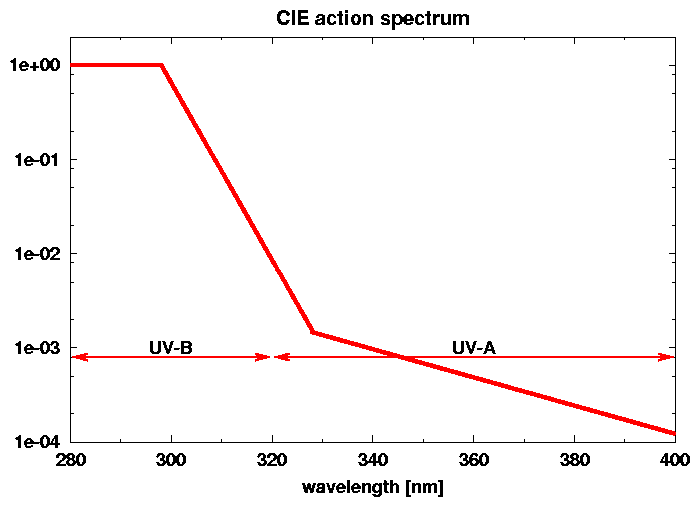
The erythemal UV index -- usually simply called the UV index (UVI) -- is an estimation of the UV levels that are important for the effects on the human skin, where 1 unit equals 25 mW/m2. It is usually given for local solar noon, when the Sun is highest in the sky, and it is valid for clear-sky conditions: effects of clouds shielding part of the UV radiation are not taken into account.The erythemal UV index is an artificial quantity derived from the erythemal irradiance, which is an integration of the UV irradiance at the ground weighted by the CIE spectral action spectrum. The CIE action spectrum is a model for the susceptibility of the caucasian skin to sunburn (erythema). It is proposed by McKinlay & Diffey (1987) and adopted as a standard by the Commission Internationale de l'Éclairage (International Commission on Illumination).
An action spectrum is a parameter function which describes the relative effect of energy at different wavelengths in producing a certain biological response. These effects may be at a molecular level, such as DNA damage, or at the level of the whole organism, such as plant growth. An action spectrum is used as a "weighting function" for the UV spectrum in an integration of the monochromatic UV irradiance.Of the global UV radiation at the ground, 94% is UV-A, 6% is UV-B.Action spectra in themselves only give an indication of the relative wavelength dependency of biological effects: the actual biological response is determined by the actual dose amount, i.e. the UV irradiance weighted with the action spectrum and integrated over the wavelength range and the exposure time, keeping in mind that the dose-response relation may not be linear.
Of the erythemal UV radiation, however, 17% is UV-A, 83% is UV-B.
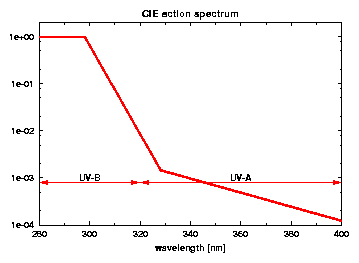
The CIE action spectrum is a model for the susceptibility of the caucasian skin to sunburn (reddening of the skin; erythema). It was proposed by McKinlay & Diffey (1987) and adopted as a standard by the Commission Internationale de l'Éclairage (International Commission on Illumination).
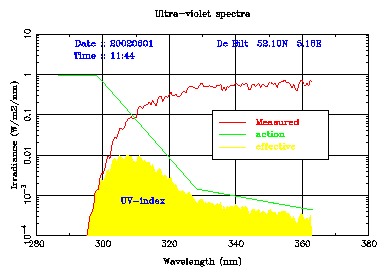
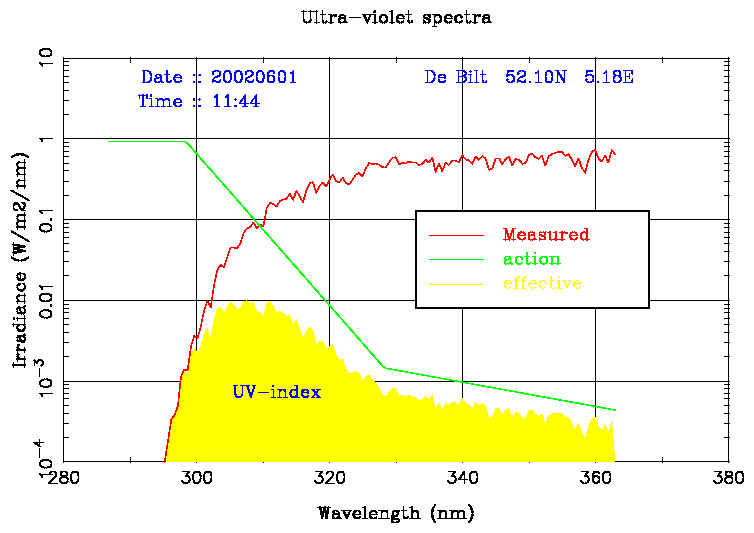
Ultraviolet spectrum measured with the Brewer Spectrophotometer at De Bilt (Netherlands) on 1 June 2002, a completely cloud-free day. Also drawn is the CIE erythemal action spectrum. The multiplication of these two gives the erythemal UV spectrum, and the surface below this graph (shown in yellow) is the UV index. The value of the UVI from this measurement is 6.3.
[ figure by Marc Allaart, KNMI, De Bilt ]Ground-based measurements such as the one from the previous graph give UVI values for these specific sites at these specific moments in time only. In order to obtain the UVI for all locations, it must be computed from total ozone amounts, in combination with the solar zenith angle (SZA): the angle from which the Sun shines. The UV index is usually given at noon of the local solar time: the moment when the Sun is highest in the sky (i.e. in the zenith); this moment is therefore not noon of the local time zone.
Ground-based measurements of the UVI and simultatiously measured total ozone column (TOC) values have resulted in a parametrisation of the UVI as function of TOC and SZA, both at local solar noon. The TOC at local solar noon is determined from satellite observations in combination with data assimilation, which uses meteorological fields (wind, temperature, pressure) to obtain a global ozone field at local solar noon. The SZA at local solar noon depends on the latitude and the day of the year.
The UV index thus is a measure for the amount of UV radiation valid for clear-sky conditions and at local solar noon. This does not say much about the daily UV dose: the total amount of UV that actually can reach the human skin during a day.
[ Top of the page ]
UV index forecast
The UV index is determined from a parametrisation as function of the total ozone column (TOC) and the solar zenith angle at local solar noon. The TOC at local solar noon in turn follows from data assimilation of satellite observations of ozone, using meteorological fields (wind, temperature, pressure) from the European Centre for Medium-Range Weather Forecasts (ECMWF).A forecast of the meteorological fields is available from the ECMWF. This enables a forecast of the global ozone field for a few days ahead. And from that it is possible to provide a forecast of the clear-sky UV index for a few days ahead -- see the near-real time UV index page.
Forecasts the UV index a few days ahead make it possible to issue warnings of possibly dangerously high values of UV radiation at the ground, that is: values markedly higher than normal for a given region.
[ Top of the page ]
Daily UV dose
The daily UV dose is an integration of the UV index from sunrise to sunset. The integration takes the cloud cover into account and thus leads to an estimate of the daily erythemal UV dose: the total amount of UV radiation absorbed by the human skin during the day, expressed in kJ/m2.For this integration, it is necessary to know what the cloud cover was for that day, i.e. how much of the sky was obscured by clouds. And it is necessary to estimate how much these clouds attenuate the UV radiation. The latter is still a matter of investigation: different types of clouds absorb the UV radiation to a different degree.
We use the cloud cover data available from geostationary satellites, to compute the UV dose of the previous day. Unfortunately, the relevant cloud cover information for yesterday's UV dose is available only for part of thw world, so that we currently can compute the daily erythemal UV dose for that part only. See our UV dose main page.
When not taking cloud cover information into account in the integration, one gets what might be called a "clear-sky UV dose": the maximum UV dose for that day, in the absence of clouds.
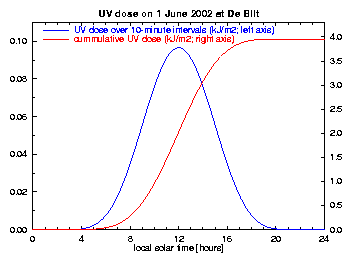
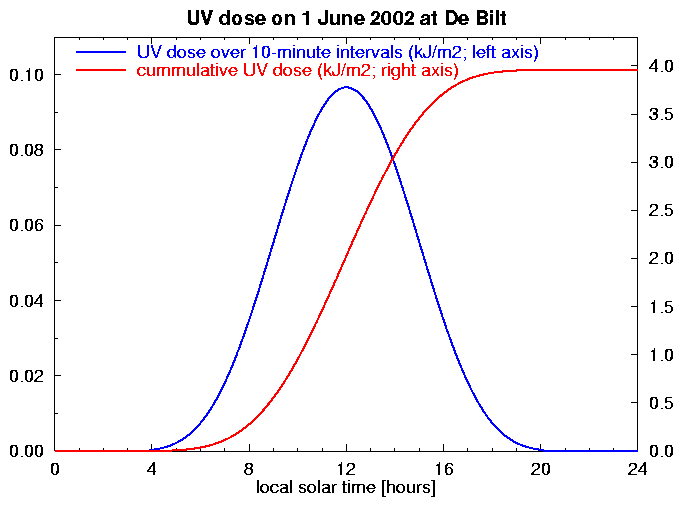
The UV dose is computed in time steps of 5 minutes and these values are summed to determine the total erythemal UV dose for the day. The blue curve shows the UV dose in intervals of 5 minutes for De Bilt (Netherlands) on 1 June 2002, a completely cloud-free day. The red curve shows the cummulative UV dose, with as end value 4.0 kJ/m2.
[ Top of the page ]
General brochures on UV radiation and health
Issues related to the effects of UV radiation on the health of human beings are summarised nicely in the Introduction of the Global Solar UV Index - A Practical Guide and some other officials guides:
[1] Global Solar UV Index - A Practical Guide
© World Health Organization, 2002
ISBN 92 4 159007 6
PDF file (439 kB) [ source ][2] UV-Index for the Public -- A guide for publication and interpretation of solar UV Index forecasts for the public prepared by the Working Group 4 of the COST-713 Action 'UVB Forecasting'
© European Communities, 2000
ISBN 92 828 81542 3
PDF file (821kB)[3 A guide to the UV index
United States Environmental Protection Agency
EPA430-F-04-020, 2004
PDF file 1.3MB [ source ][ Top of the page ]
 last modified: 21 February 2022
data product contact:
Jos van Geffen & Michiel van Weele &
Ronald van der A
Copyright © KNMI / TEMIS